
*As an Amazon Associate, I earn from qualifying purchases.*
7 Sacred Amazigh Rug Symbols: The Ultimate Secret Guide to Indigenous Codes
“Every knot is a silent whisper, and every pattern is an ancient diary woven in wool by hands that guarded the secrets of the Atlas Mountains for millennia.”
Imagine walking into a room and realizing that the beautiful, rustic textile lying on your floor isn’t just a decorative piece, but an unread historical manuscript. For centuries, the indigenous weavers of North Africa have used intricate Amazigh Rug Symbols as a deeply personal, non-verbal language. Long before written alphabets dominated the region, these women mapped their lives, their spiritual protection, their fears of the unknown, and their deepest desires directly into the warp and weft of raw sheep’s wool. In this ultimate guide, we will decode the mesmerizing secrets of these tribal glyphs and show you how to read the ancient matrix of Moroccan rugs.
 Guided Map to the Woven Matrix
 The Silent Language of the Atlas Weavers
The art of weaving in the Atlas Mountains is not a mere industry; it is a sacred, meditative practice. When an Amazigh woman sits before her vertical loom, she enters a dialogue with her ancestors. Using raw, hand-spun wool tinted with organic vegetable dyes—indigo, saffron, henna, and wild madder root—she weaves her personal biography. Each rug is entirely unique, displaying variations that reflect her emotional state, life events like marriage or pregnancy, or warnings about local tribal conflicts.
Unlike mass-produced machine rugs that replicate sterile, perfectly symmetrical patterns, authentic hand-knotted rugs are gloriously imperfect. These intentional shifts in design and sudden changes in color are called *el-khta* (the mistake), which the weavers deliberately introduce because they believe only God can achieve absolute perfection. These anomalies are where the true soul of the textile resides.
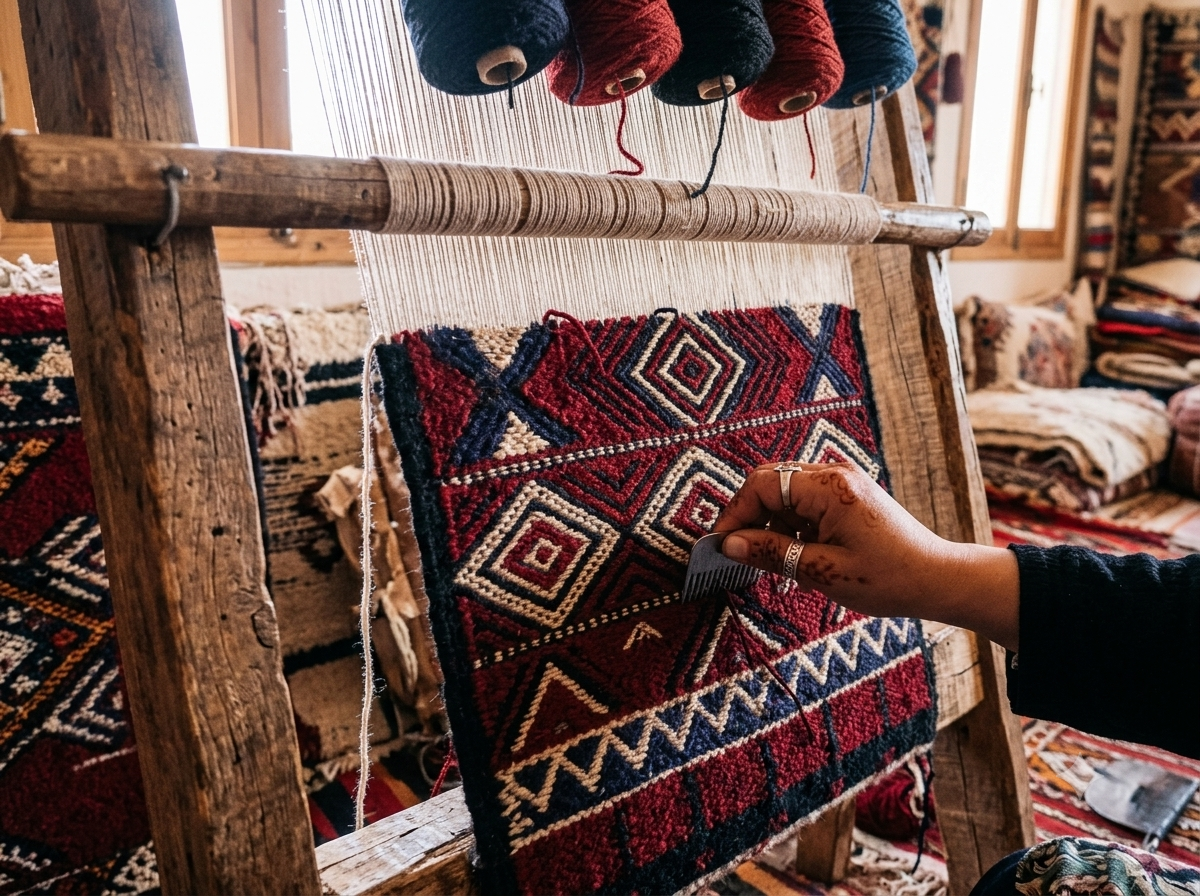
Intricate geometric patterns representing centuries of oral history and spiritual protection.
 7 Most Powerful Amazigh Rug Symbols Decoded
To read a rug, you must learn to recognize its alphabet. The geometric structures woven into the fabric are not random tribal decorations; they are loaded with specific intentions. Here is a breakdown of the seven most common and powerful Amazigh Rug Symbols you will encounter:
 The Diamond (The Eye & Protection): The diamond is the supreme protective shield. It is woven to ward off the *Evil Eye* (L’âyn) and to trap negative energies inside its sharp corners, safeguarding the household from jealousy and misfortune.
 The Frog (Fertility & Transition): Depicted as a series of nested diamonds or small geometric shapes with legs, the frog represents absolute fertility, new beginnings, and smooth life transitions.
 The Crab or Spider (The Weaver’s Protection): This symbol represents the sun’s rays and the sacred act of weaving itself. It serves as a tribute to patience, hard work, and cosmic order.
 The Chevron (The Flow of Water): Zigzag lines running across the rug represent flowing rivers, a symbol of pure life, nourishment, and physical and spiritual abundance.
 The Tree of Life (Ancestral Roots): An upright linear structure with branches pointing skyward, honoring the deep connection between the earth, human lineage, and the divine.
 The Lizard (Elevation & Light): Represents the human soul seeking divine light, wisdom, and spiritual elevation.
 The Scissors or Metal Tools: Woven as small sharp triangles or metallic lines, these represent metal weapons used to actively slice through dark magic and block bad spells.
How to Spot a Genuine Hand-Knotted Masterpiece
Due to the explosive global demand for the minimalist, tribal look in high-end bohemian home decor, industrial factories have flooded the market with synthetic imitations. Buying a machine-made copy completely strips the product of its ancestral soul. To ensure you are investing in an authentic heirloom, you must look for the following signs:
First, always flip the rug over to inspect its back. A genuine hand-knotted rug will show irregular, uneven knots of various sizes, whereas machine-made rugs display absolute grid-like uniformity. Second, look at the fringe; on a genuine rug, the fringe is an extension of the warp threads (the very backbone of the rug) rather than being sewn onto the edges later. Finally, genuine wool has a subtle, earthy, and natural smell that synthetic fibers simply cannot replicate.
If you want to bring these powerful protective elements into your home, you can find the highest-rated authentic hand-knotted Moroccan rugs on Amazon. Investing in a real piece of Atlas history ensures that these protective glyphs guard your space for generations.
 Styling Your Modern Salon with Ancestral Energy
The timeless beauty of Amazigh Rug Symbols is that they effortlessly bridge the gap between ancient heritage and modern interior design. Whether you are aiming for a warm, minimalist Mid-Century Modern salon, or a vibrant, textures-on-textures Bohemian sanctuary, a hand-knotted rug acts as the perfect grounding anchor for your entire room.
To create a balanced, luxurious atmosphere, pair your rug with organic textures: raw wood coffee tables, warm terracotta planters, and hand-carved cedar furniture. To add the perfect finishing layer of comfort, look into styling your seating with vintage hand-woven floor cushions and poufs on Amazon. This layering technique instantly elevates your space, transforming a standard modern living room into a deeply inviting, soulful sanctuary filled with ancient stories.
Ultimately, choosing to decorate with authentic rugs is not just about aesthetics—it is a conscious act of keeping ancient cultural preservation alive. By learning to decode the rich language of weaving and choosing hand-made masterpieces, you bring the deep, protective magic of the Atlas mountains directly into the heart of your home.
Read the Threads. Honor the Weavers. Protect Your Space.