
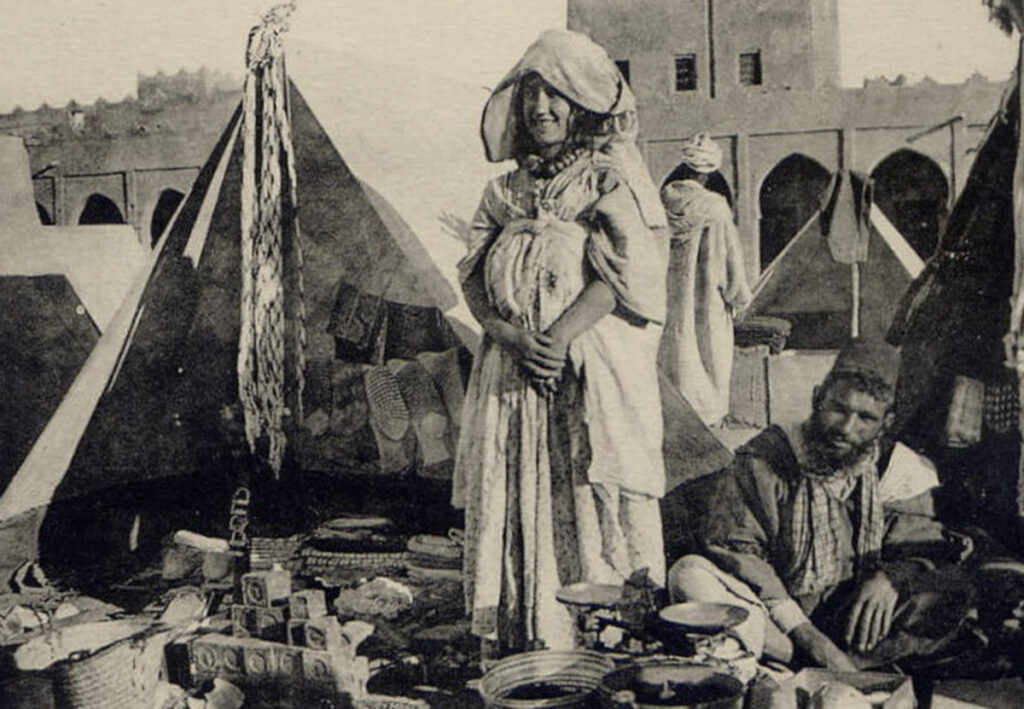
The Jewish heritage in Sous Morocco represents one of the most fascinating chapters of North African history. For centuries, in the heart of the Sous Valley—from the fortified walls of Taroudant to the remote oases of Tamanart and Akka—Amazigh Jews and Muslims forged a unique model of coexistence.
These communities did not just live side by side; they shared a language, a land, and a profound cultural identity that still echoes in the silver jewelry of the Atlas and the ancient ruins of the Mellahs. In this article, we explore the deep roots, traditions, and lasting legacy of the Jewish communities in the Sous region.

“A historical scene reflecting the daily life of the Jewish community in the Sous region, where trade and silver crafting were the pillars of their presence.”
The Geography of Jewish Heritage Coexistence: Taroudant and the Mellahs of Sous
The Jewish presence in the Sous region was strategically concentrated in vital urban centers and trade hubs. In Taroudant, often called “The Grandmother of Marrakech,” the Mellah (the designated Jewish quarter) was a bustling center of craftsmanship and commerce. From the 16th century onwards, these communities became an integral part of the city’s economic fabric.
Beyond the city walls, the influence of the Jewish communities extended to the remote oases of Tamanart, Akka, and Ifrane of the Anti-Atlas. These locations were not chosen by chance; they were critical stops along the ancient Saharan trade routes. Here, Jewish traders acted as essential intermediaries between the Berber tribes and the wider commercial world.
Living in the Mellah was not merely about separation; it was a social structure that allowed these communities to maintain their religious traditions and Hebrew courts while being deeply embedded in the Amazigh local markets (Souks). They were the masters of silver smithing and salt trade, skills that earned them respect and protection from local tribal leaders.
The Geography of Coexistence: Sacred Spaces in Sous
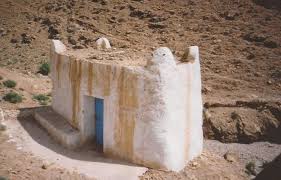
The ancient synagogue of Ifrane Anti-Atlas: A symbol of centuries-old peace in the Sous mountains.
The presence of Jewish communities in Ifrane Anti-Atlas and Tamanart was not merely commercial; it was deeply spiritual. These ancient stone synagogues, built with the same local materials as the surrounding Amazigh homes, prove that “coexistence” was a lived reality etched into the geography of the land.
Living in the Mellah allowed these communities to protect their Hebrew traditions while being inseparable from the Amazigh social fabric. In the Sous valley, the sound of the synagogue prayers often blended with the daily life of the neighboring Muslim community, creating a unique model of tolerance.
Tiznit: The Silver Capital and the Legacy of the Mellah
No exploration of Jewish heritage in the Sous region is complete without mentioning Tiznit. The Mellah of Tiznit was the heartbeat of the silver industry, where Jewish masters perfected the art of goldsmithing.

A Jewish silversmith in his workshop, maintaining the ancient traditions of Tiznit silver.
The Jewish community were the first to extract metal from the Anzi silver mine, teaching their Amazigh neighbors the intricate techniques of filigree and engraving that define the city’s identity to this day.
Conclusion: A Legacy That Never Departed
The mid-20th century marked a turning point for the Jewish communities of the Sous region. While many families moved to Israel, France, or North America, they never truly left the mountains and valleys of the Anti-Atlas. The bonds formed over a millennium of shared life—speaking the same Tashelhit language and celebrating common traditions—remained etched in the collective memory of the local Amazigh population.
In cities like Tiznit and villages like Ifrane Anti-Atlas, the physical traces of the Mellah and the silent synagogues stand as monuments to a “Millenary Coexistence”. Today, the Muslim population often remembers their former neighbors with great fondness and regret, recalling a time when the marketplace was a mosaic of pluralism.
The story of the Jews in Sous is not a closed chapter of the past; it is a living part of the Moroccan identity. Through the preservation of the silver craft and the restoration of historical sites, the “Amazigh Legacy” continues to honor a time when two faiths shared one land, one language, and one soul.
